I’ve been to a lot of tech conferences. This wasn’t one of them, and honestly, it’s the one I’ve learnt the most from in a while.
Last week I was in Brisbane for the SMA and ACSEP conference, running a session on AI in clinical practice with Mark Fulcher and Kim Archibald. A big thank you to ACSEP for having me, and to Mark and Kim for welcoming me to present with them. I went in as the lone AI person in a room full of clinicians, and was welcomed with open arms. I’m still turning over what I took from it, and most of it is about how they think rather than what they know.
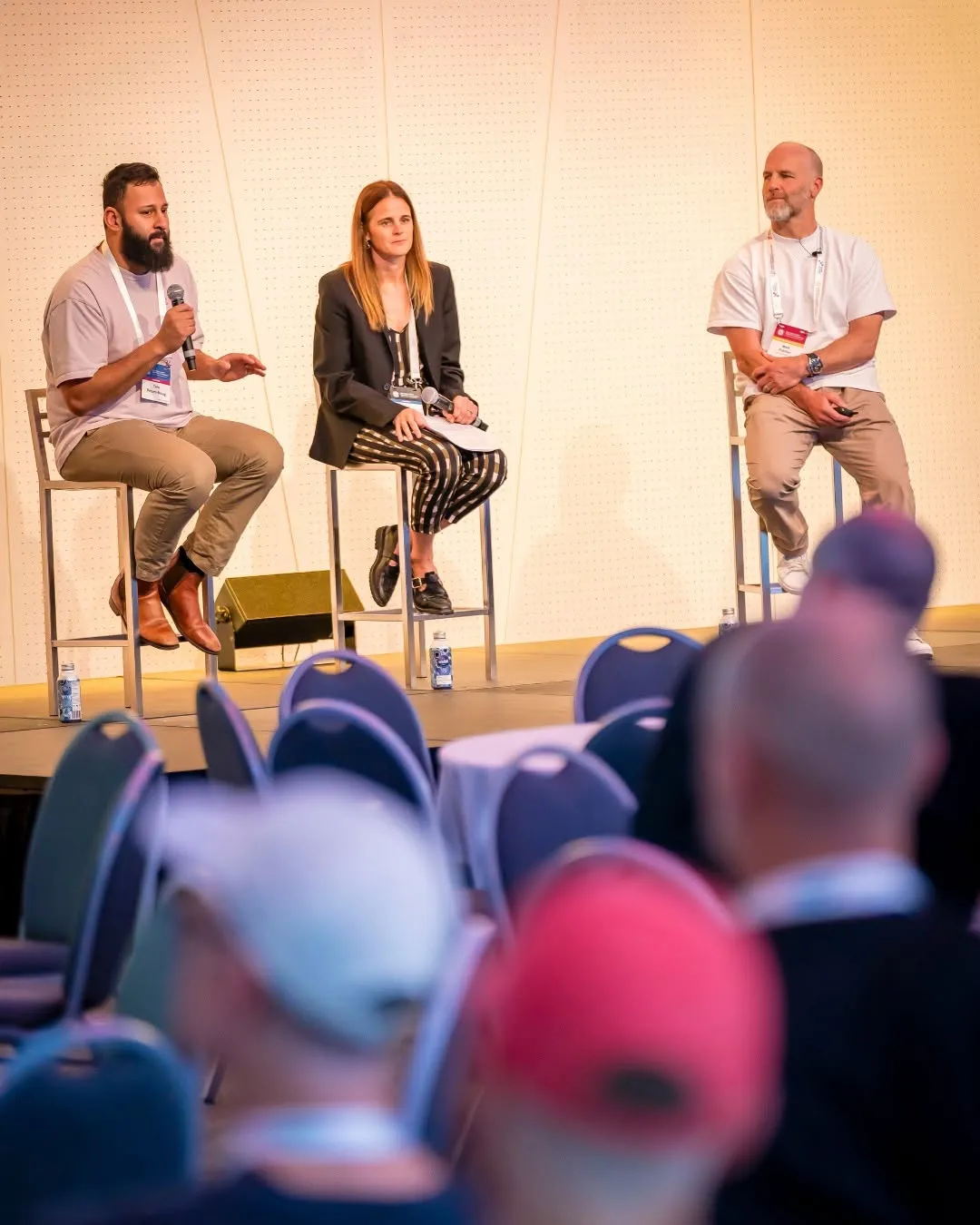
Taru Peters-Naug, Kim Archibald and Mark Fulcher presenting on AI in clinical practice at the SMA and ACSEP conference in Brisbane.
If you’ve only ever been to tech conferences, it’s worth explaining how this one ran, because the format does a lot of the work. It brings together clinicians working in sport and exercise medicine, and the programme is a mix of session types rather than a run of keynotes.
A lot of the sessions are research presentations, where someone takes the room through a study: the method, who was in it, how the data was collected, what they found, and what they’re careful not to claim. Some sessions exist to go through published papers and work out whether they hold up. Others are case discussions, where a real patient case is worked through live by clinicians from different specialties. Then there are the more familiar ones, a talk on a topic or a tool, and workshop style sessions like ours.
That mix is the bit I’d been missing. In tech the default is someone on a stage telling you what they built and why it worked. Here a decent chunk of the programme is people examining evidence in public, including their own.
Being questioned (in a good way)
It was really good to finally talk about what we’ve built to a wider room of physicians. And understandably, there was some hesitation. How much is the AI doing? How much is the clinician still thinking?
Those are exactly the right questions. The things we use AI for aren’t replacing clinical decision making. They’re meant to make those decisions easier, by showing clinicians information in a better way and clearing away some of the work around the edges that slows them down.
I won’t pretend we won everyone over in one session. But I really enjoyed being questioned. It’s a much better conversation than people nodding along, and it pushed me to be clearer about what we’re doing, how we are being safe and why we are doing it.
Showing your working
The thing I keep coming back to is how seriously the science was taken. Talk after talk started with the method. How was the data collected? Who was in the study? What are the limits? Then people moved on to what it might mean, not what it definitely means.
And people were really open about the holes in their own work. I didn’t hear anyone pretending their paper was the final word.
One session stuck with me. A group pulled apart a narrative review that had been published. The paper used very confident language and pretty much dismissed a particular treatment. But the evidence didn’t back that up, and even the paper’s own findings didn’t. The worry in the room was simple: this paper is out there now. People will cite it. That strong language will get repeated, and it probably needed more scrutiny before it ever got into a journal.
I sat there thinking about how often we do exactly that in tech. A confident blog post or launch announcement goes out, everyone quotes it, and not many of us go back to check whether it held up.
The method is the reason
I talked about this in our session too. Healthcare gets called slow, and from the tech side that’s usually meant as a criticism. It’s never really looked that way to me. It has to work differently from tech, and this week gave me a much better understanding of why.
The scientific method is actually being applied, in the room, out loud. A claim gets made, the evidence behind it gets examined, other people try to pull it apart, and it only moves forward if it survives that. The pace is what that process costs. It isn’t people being timid.
The stakes do play a part. If we ship a buggy feature, we roll it back. In health, the consequences land on a patient. But I don’t think that’s the whole explanation, because the same habit of showing your working was there even when nothing much was riding on it.
They treat the whole situation as the problem
The session that stuck with me most was Bone Stress Matters, with Dane Baker, Dr Sarah Beable and Dr Katie Wyld, where a case was worked through in front of the room. What got me wasn’t the diagnosis. It was how much of the conversation was about everything around it. Training load, nutrition, where the athlete was in their season, what they were under pressure to get back to, who else was involved in their care. The athlete’s mental state came up as much as anything physical, and it wasn’t a footnote at the end. It was part of the picture from the start.
In tech we’d call all of that context, and we’d park it to get to the real problem. Here it seemed to be the problem. Different clinicians took the case in different directions and built on each other’s thinking out loud, in front of everyone. I haven’t seen much like it at a tech conference, and I’ve been wondering since what it would look like if we tried.
What I’d love to borrow is the format itself. A genuinely tricky problem, nobody pretending to have the whole answer, and people from different specialties and backgrounds thinking out loud in front of a room. The mix of perspectives was the point, not a nice extra.
I’m not sure what the tech version of that looks like. Our closest equivalents are usually a post-mortem after something has already gone wrong, or a demo where the answer was decided weeks ago. Neither is really the same thing. I’d like to work out what is.
What came through in that session, and in most of the others, was how much these people genuinely care about the work. Not just the interesting cases. Athletes and patients across the board, in all sorts of situations.
Health professionals really love data
There was a talk on data in healthcare that I really enjoyed. They were working in R, and I’ll admit I quietly ran some of it through Claude during the session. What struck me was how data-driven the whole profession is. From where I was sitting it didn’t look like a nice-to-have, it looked like the core of how decisions get made.
That’s exciting for people like me. There’s a lot of overlap between how clinicians think about evidence and how we should be thinking about AI: be clear about what you know, be honest about what you don’t, and don’t oversell it.
The people and the family
I was lucky enough to go to the gala dinner and hear about the journey people take to become fellows of the college. It’s a long road, and it showed.
My overall takeaway is that I was surrounded by amazing, smart, driven people with a huge range of experience, and all of them were really happy to share it. It didn’t feel competitive the way some tech conferences do. Nobody was working the room to land a deal. People wanted to understand each other’s perspectives, understand the science, and work out how to take better care of patients.
The part I didn’t expect was how much of that night was about family. Becoming a fellow isn’t something people do on their own. It means moving cities, years of study stacked on top of already long hours, and a lot of time away travelling with sports teams. That load lands on partners and kids just as much as it lands on the person whose name ends up on the qualification.
And the room knew it. The support for the families was genuine, not a polite line in a speech. You could tell nearly everyone there had either lived it themselves or watched someone close to them go through it.
It wasn’t flashy. It was thoughtful, and it was really about sharing the journey and celebrating people for who they are.
Learning goes both ways
I’m really grateful I got to go. As a non-physician in a room full of physicians, I felt genuinely welcomed. People were happy to talk to me and really curious about where AI might fit into their world. I loved being the AI person in the room, and this isn’t a fluff line: I’m genuinely excited. Health has things to learn from tech, sure. But I think there’s even more for people like me to learn from health, and there’s a lot of room for the two to work together properly. If I take one habit home from the week, it’s showing the working: being clear about what I know, what I don’t, and how I got there.
One last quirky thing: almost nobody was on LinkedIn. So if we met and I asked for your email instead, that’s why. It was great meeting you all, and I’m looking forward to keeping the conversations going.